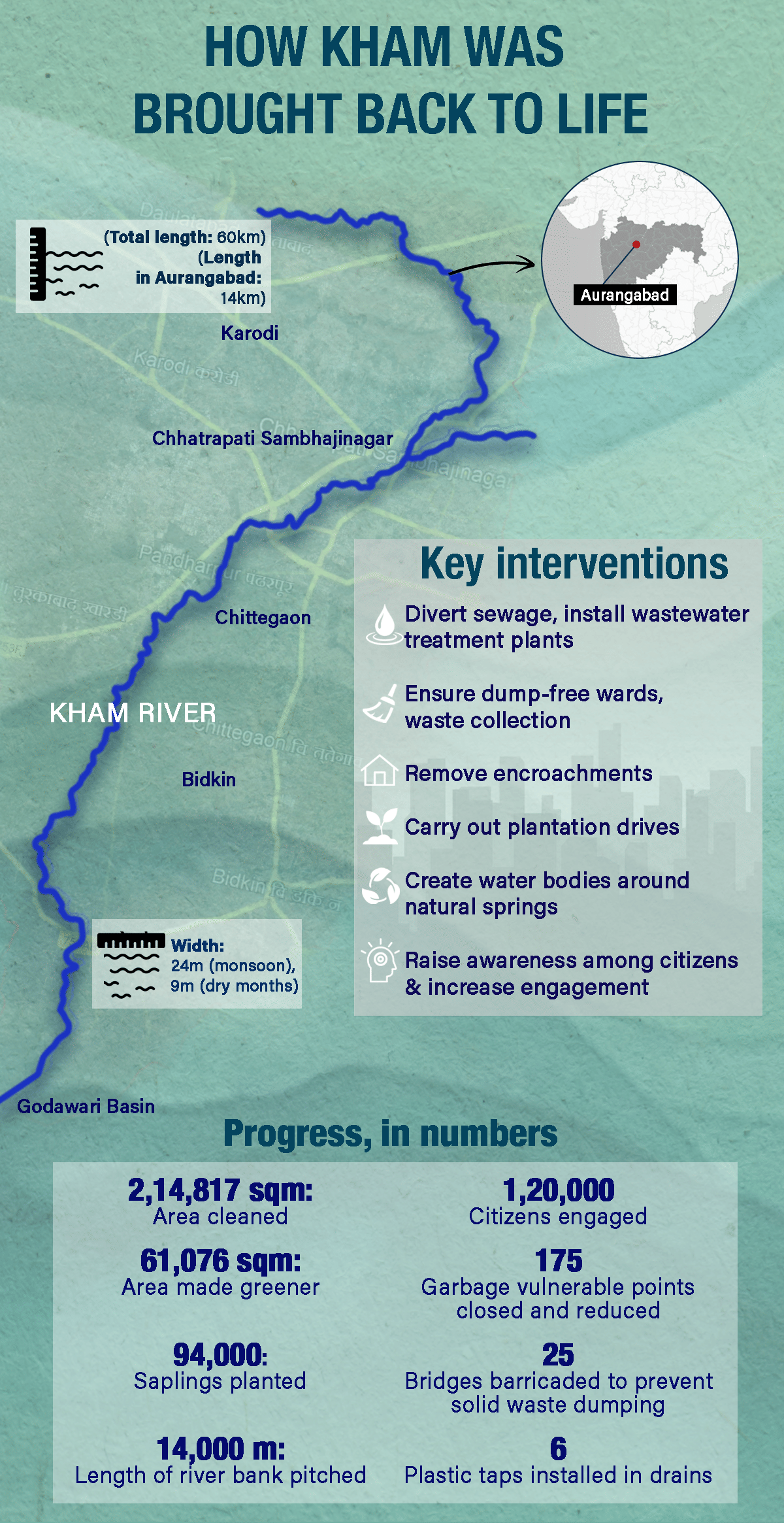
Kham, a 60 km tributary of Godavari that originates in Chhatrapati Sambhajinagar, was always such a waterway. But, as it meandered through the city and flowed downstream through the district, it was reduced to an open drain.
Persistent efforts over the past few years have revived the river. Fresh water now flows through the state’s tourism capital, and spaces created along its banks are full of life, reclaimed by city dwellers. There’s a dedicated track for joggers and cyclists, a women’s gym, a children’s play area and benches under tree canopies.
Kham’s revival began in 2016 when the Confederation of Indian Industry (CII), a local company Varroc Engineering and the Cantonment Board identified a highly polluted stretch near a historical bridge. The spot, which connected the cantonment area with the rest of the city, was also a symbolic entry point into Aurangabad, particularly for those arriving from Pune.
By 2019, the project took a decisive turn as the municipal corporation and non-profit Ecosattva Environmental Solutions got involved. What followed was a six-month diagnostic phase using GIS (geographic information system) mapping, drone-based surveys and extensive fieldwork. The team mapped 14 kilometres of the river in the city and 8.8 kilometres of a stormwater drain feeding into it.