
Rasta Satyagraha- Part 1: When the System Didn’t Move, Chaitanya Patil Walked the Mumbai-Goa Highway CITIZEN WALKS WHERE SYSTEM FAILED Mumbai–Goa National Highway (NH-66), Maharashtra https://www.moneylife.in/article/rasta-satyagraha-part-1-when-the-system-didnt-move-chaitanya-patil-walked-the-mumbaigoa-highway/79178.html

Chaitanya Patil (28), an engineering graduate from Raigad, has completed a 490-km on-foot audit of the battered Mumbai–Goa highway and submitted a 59-point hazard report to Union Road Transport Minister Nitin Gadkari.
‘RASTA SATYAGRAHA’ — A WALK OF SHAME FOR BAD ROADS
•Walked entire NH-66 stretch •Duration: 29 days
•Identified: •Potholes, •Missing signage, •Incomplete bridges, •Accident black spots, •Exposed iron rods & debris
59 critical danger points documented with: •GPS data, •Photos, •QR-coded digital report
75–85 km of work still pending, Service roads incomplete, Bridges half-done, Lives fully at risk
Patil even collected accident-causing debris by hand — broken glass, metal pieces, hoardings — items that authorities somehow “missed” for years.
WHO IS CHAITANYA PATIL?
•Engineer from Kasu village, Raigad
•Flagging highway flaws since 2019
•Earlier complaints led to repairs within 24–48 hours
•Proved one thing brutally clearly:
Problems exist because silence is convenient, not because solutions are hard
Wa by Jaikishin.. When a citizen walks half a thousand kilometres to do what institutions were paid to do— It’s no longer activism. It’s an indictment.
The road to Goa shouldn’t require courage. It shouldn’t require sacrifice. And it certainly shouldn’t require a Satyagraha. Fix the roads — before more citizens have to walk over broken promises.
New Court Order May ERASE The Aravallis, Expose Hills To Mining & Construction https://www.youtube.com/watch?v=nplSe5cTpcc Let's Get Real -- we’re not talking about the Aravallis being destroyed by bulldozers. We’re talking about something far quieter—and far more dangerous - they're being erased by definition.
A technical change in a ruling by the Supreme Court has quietly reclassified over 90 percent of the Aravallis as 'non-Aravalli', stripping them of legal protection.
This change in definition could decide the future of our air, water, biodiversity and climate in Delhi–NCR, a region already gasping for breath, and dealing with deangorus levels of pollution.
Modi’s Own Invisible Man: Hiren Joshi’s Rise and Retreat https://thewire.in/politics/hiren-joshi-narendra-modi-pmo In Modi’s era, the power over information has tightened into a centralised machinery where messages are crafted, curated and released with calculated precision. At the heart of this ecosystem stands Joshi, the prime minister’s discreet yet formidable media aide.
Many journalists privately claim that he keeps dossiers on Modi’s critics, tracking their posts, their patterns, even the private corners of their lives. It is also an open secret that Joshi commands the loyalty of BJP’s IT Cell, a digital ‘troll army’ known to influence trends, drown dissent and smother inconvenient facts under waves of coordinated outrage.
The Coal-hell called Singrauli https://www.facebook.com/reel/1531647991389873 600000 पेड़ कटेंगे? Gautam Adani के प्रोजेक्ट के खिलाफ आदिवासी क्यों? Singrauli में ऐसा क्या हो रहा? (Where some of us have worked with the local movements and against rampant displacement, deforestation, coal mining and coal power plants -- from 2008--09 onwards, till around 2015-16.
https://www.youtube.com/watch?v=GILGrwWA8-8
https://www.youtube.com/watch?v=bBbqDlS2zOM
https://www.youtube.com/watch?v=0QhJk65TLe0
more than 50% MSMEs in pharma to be shutdown early next year.. https://youtu.be/xAs3gMk0e8Y Anshuman Tiwari says The risk of closure has increased for nearly 60% of pharma MSMEs. these companies have not yet adopted Good Manufacturing Practice (GMP) rules, There are approximately 8500 pharma MSMEs that have not yet implemented these rules.
the working methods of these pharmaceutical companies, including adulteration and the mixing of toxic substances in medicines, have damaged the reputation of the Indian pharmaceutical industry worldwide. new GMPs will come into effect from January 1st. There are approximately 10,000 to 12,000 pharmaceutical units in India, of which 8,000 to 9,000 units will close down. This is because the 60% of small and medium-sized companies do not have enough investment or technology to implement the new Good Manufacturing Practice plan.
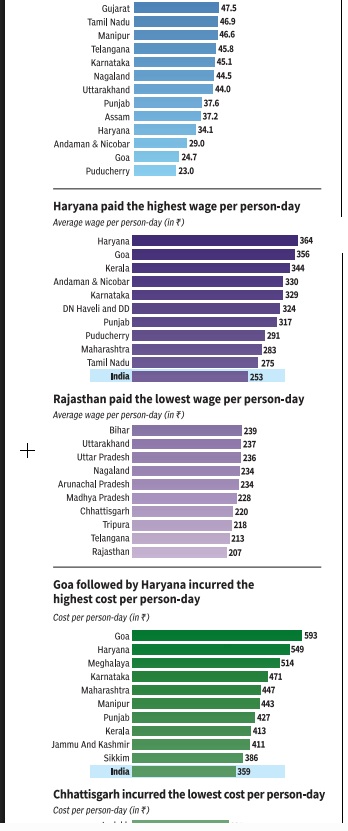 Work days up but Centre may spend less in rural job scheme https://www.thehindubusinessline.com/economy/work-days-up-but-centre-may-spend-less-in-rural-job-scheme/article70408014.ece COST-EFFECTIVE. Analysis points to a contraction in the actual reach of MGNREGA By 2024-25, this number slipped to 50 days, with the Centre's contribution falling to ₹85,640.55 crore. While households received 48-52 days of work annually over the past five years, the average dropped to about 36 days so far this fiscal, with the Centre's spend at ₹69,013.73 crore.
https://www.thehindubusinessline.com/economy/government-fails-to-table-viksit-bharat-g-ram-g-bill/article70399997.ece Despite being slated for introduction in the supplementary list of Lok Sabha business, the government did not table the Viksit Bharat Guarantee for Rozgar and Ajeevika Mission (Gramin) Bill, 2025 (Viksit Bharat-G RAM G) on Monday. This Bill proposes replacing the 2005 Mahatma Gandhi National Rural Employment Guarantee Act, deleting the name of the Father of the Nation from its title, an omission that was roundly criticised by the Opposition.
the fund-sharing pattern between the Centre and the States. Section 22 mandates the ratio of fund sharing between Centre and northeastern/Himalayan States as 90:10 while it will be 60:40 for all other States and UTs with legislature. It also said beyond 125 days, it will be the responsibility of the States to bear the expenditure.
https://theprint.in/opinion/vb-gramg-bill-strikes-heart-mgnrega/2807902/ MGNREGA’s core strength was: if you needed work, you got work. VB-GRAMG’s funding model means work will only be available if a state has the budget and the Centre has approved the allocation.
https://www.downtoearth.org.in/governance/two-decades-of-the-right-to-work-under-mgnrega-and-the-turn-we-are-taking-now Most MGNREGA workers are marginal farmers or landless labourers who turn to public works under NREGA precisely when they do not have anything to do and their agricultural incomes are low, uncertain, or delayed. A legal ban on work during certain months limits their choices and does not protect livelihoods. It replaces this rights-based framework under the Act with a behavioural tone decided by the state and the arrangement of workers deciding when they need employment to one where the state decides when the poor are allowed to work and when they are not.
Silence of the Looms: Inside Story of How a New Textile Policy Proposal Could Hand Reliance Windfall Gains at the Expense of Small Enterprises and Crores of Workers: https://newdelhipost.co.in/9637-2/
For Adani Group’s Projects, Gujarat Requested Centre to Remove Forests from Conservation Program. The Job Got Done. https://www.reporters-collective.in/trc/for-adani-gujarat-requested-centre-to-remove-forests-from-conservation
https://countercurrents.org/2025/12/george-carlins-obedient-america/
Currently in America, a very dark brand of obedience serves to confirm the sarcasm George Carlin leveled at America’s socio/economic system which takes advantage of a complaisant public, and when this obedient public does not exert sufficient pressure on political leaders, it grants “silent permission” to avoid or radicalize crucial issues such as climate change, uniform tax policy, proper medical treatment, and fair societal policies.
This darkness transfers control by allowing extreme divisive rhetoric to become normalized, in power, in control. Then political dialogue easily shifts to extremism, a very effective tool of control, marginalizing minority groups, intensifying social divisions. This is how societies and ecosystems go “extinct from politeness,” a term coined by Caitlin Johnstone. journalist, essayist, painter and poet: Faces Of The Empire: The Battle For Humanity’s Soul (November 2025)
When the government and the media lie to us or share information that doesn’t align with our experience, it feels like honesty and integrity for America as a whole are eroding. Perhaps President Herbert Hoover said it best back in the 1930s when he observed, ‘When there is a lack of honor in government, the morals of the whole people are poisoned.’ Lying creates a kind of trickle-down corruption and the average citizen’s reasoning can quickly become: “If the government can, then why can’t I?”” (Is Morality in Decline or Is It Being Manipulated? Psychology Today)
15/12/2025
ये किताब भेज दूंगा, पढ़ लेना… | सबूतों के साथ जयराम रमेश से मोदी सरकार को घेरा| https://www.youtube.com/watch?v=1FjBVv9me_g Jairam Ramesh
- The Mighty Fall of the BJP: How Power Lost Control in Parliament
- Section 144 Misuse in Petition Filed by Anti-CAA Protesters
- Supreme Court orders voice test of UP DIG accused of communal slur; quashes case against Muslim man
- Gift Sustainability, Celebrate Culture: The Aadivasi.org Revolution
- Baba Adhav, amar rahe
- Now I know why they banned this documentary.
- Malvani Land Crisis
- ‘Intellexa Leaks’: How a US-sanctioned, Israeli spyware was used on Pakistanis
- UP - 200 crore on nee State office
- India’s new data rules put the state above citizens
- Anand Teltumbde: How India’s new labour codes dismantle worker protections
- LIC Has Invested Rs 48,284.62 Crore in Adani Group Companies: Government
- ALL the PMs men!
- Laboured Codes
- The Balance Sheet: World Bank & its 80-year legacy
- India orders phone companies to install govt cyber safety app in every phone
- Not just Tree Cover alone
- AQI 400 Paar! But We Are Obsessing Over Modi's Emosaans & Urban Naxals
- Story of Mumbai’s Working Class Movement
- New Labour Codes according to Labour Secretary