
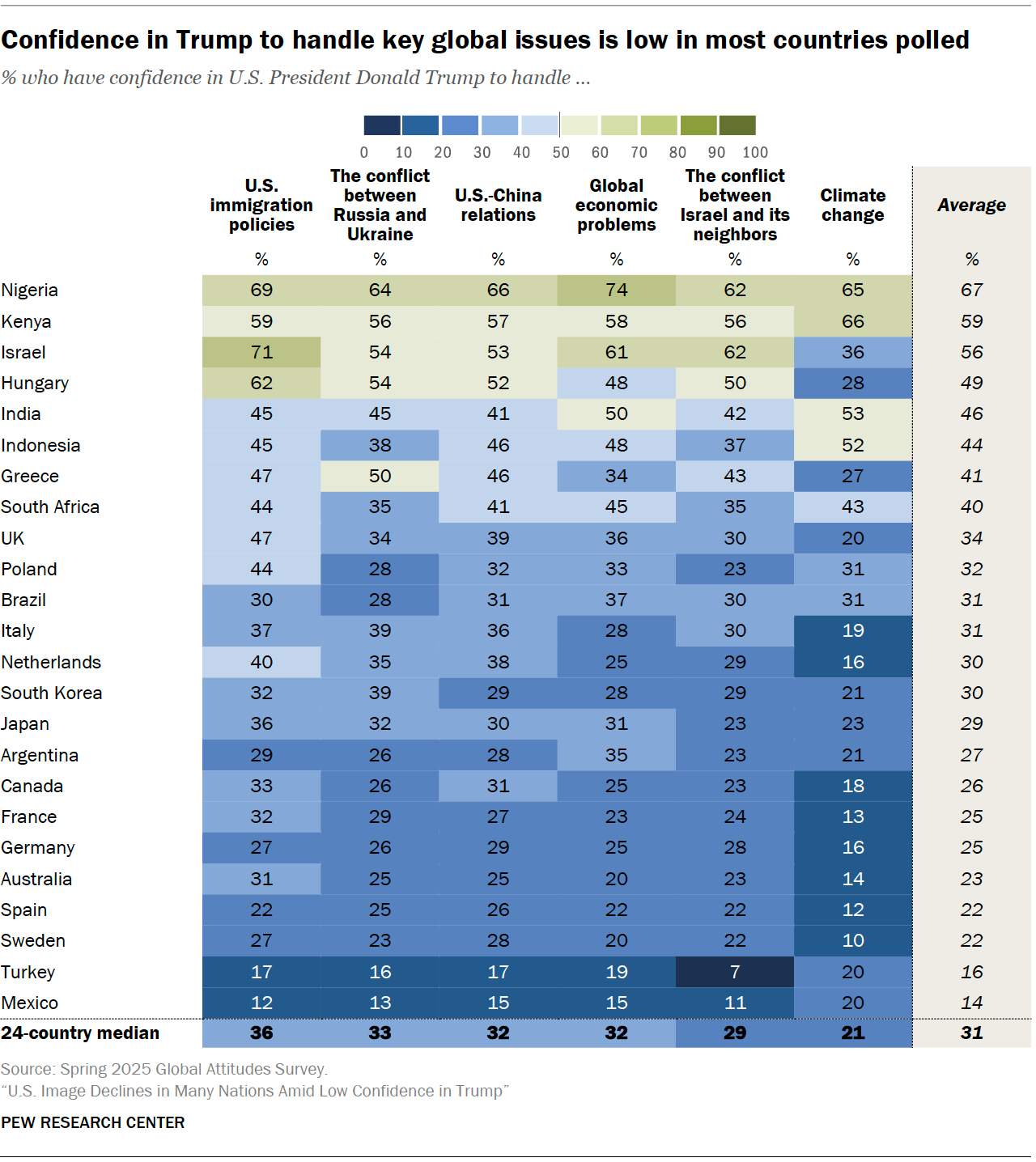
https://www.pewresearch.org/global/2025/06/11/confidence-in-trump-to-handle-global-issues/ India is among the top five countries have confidence in Trump. Note the confidence on Trump in India on the Issues of Climate Change confidence was 53%!
https://www.youtube.com/watch?v=gDRVxlMjebI Jun 12, 2025 Nope w/ Kunal Kamra Former General Secretary of All India Bank Officers Confederation and currently coordinates the Peoples Commission on Public Sector and Public services. so today the corporates are getting such cheap credit The RBI data now shows that 449 people in this country corporates who have a loans above 100 cr they are given loan at 4% rate of interest
मणिपुर के हिंदुत्ववादी आपस में क्यों लड पडे?Manipur violence: Why Arambai Tenggol is up against BJP? https://www.youtube.com/live/ygQU_w7OygU
मोदी ने गोदी मीडिया का खेल शुरू किया। राहुल ख़त्म करेंगे https://www.youtube.com/watch?v=nsoPeHNW7uI | Pradeep Chauhan
Pradeep Chauhan explains how Prime Minister Narendra Modi’s administration has leveraged sympathetic “Godi Media” outlets to control the national narrative—and why Rahul Gandhi represents the strongest force to challenge and ultimately dismantle this media hegemony. We’ll trace the evolution of government–media relations over the past decade, spotlight key moments when pro-government channels shaped public opinion, and examine Rahul Gandhi’s strategic media interventions aimed at restoring journalistic independence.
Origins of “Godi Media”: How certain news networks aligned with government messaging. Mechanisms of Influence: Advertising revenue, editorial pressure, and curated coverage. Turning the Tide: Rahul Gandhi’s media campaigns, public addresses, and social media strategies. Implications for Democracy: Why a free press is vital, and what a post-“Godi Media” landscape could look like. trancript & Trans "J:\fortransfer\godimedia.html"
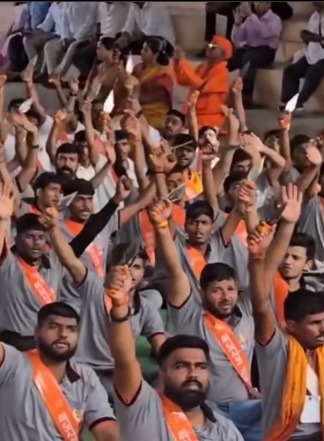 https://wuuuww.instagram.com/reel/DKnWNcUtwye/?igsh=OTJxa3JubzN6ZGtm Location: Nigdi Pradhikaran, Pune, Maharashtra
Date: May 31
VHP-Bajrang Dal held a Trishul Deeksha and Shaurya Sanchalan, during which participants marched holding swords and took oaths wielding trishuls.
Also from Hindutva watch:
uuuu uuu
uuu
BJP making India a very hateful country': https://www.youtube.com/watch?v=GjJKiwk3tQY India is drowning in fake news. And much of it is produced by its own political parties. Dedicated "IT cells" supported by highly paid consultants push disinformation on social media with the aim of converting voters to their point of view.
And this isn't limited to elections. Disinformation is warping Indian society itself. The past decade has seen an explosion of hate, a significant part of which has been powered by fake news.
The first line of defence against this tsunami? Fact checkers.
To understand how fact checkers battle this scourge, Scroll's political editor, Shoaib Daniyal, speaks to Alt News co-founder Pratik Sinha on the first episode of Scroll Adda.
Vijay Mallya opens up on Kingfisher vs Air India, blames ‘animosity and jealousy’ for intense scrutiny
Story by Eshita Gain Vijay Mallya breaks his silence on the government ignoring Air India's failure and unfairly targeting Kingfisher Airlines, citing “a combination of jealousy and animosity” as the prime factors in the intense scrutiny of his now-defunct company.
Vijay Mallya Podcast: Rise & Downfall Of Kingfisher Airlines, Loans & RCB | FO364 Raj Shamani
Raj Shamani https://www.youtube.com/watch?v=MdeQMVBuGgY
पहली बार Vijay Mallya ने लिया Modi का नाम | विदेश से सबूत दिखाए,झूठ पकड़वाया? https://www.youtube.com/watch?v=nEgqafOAtL0
Kumkum Binwal Jun 6, 2025 Fugitive businessman Vijay Mallya, who is facing fraud and money laundering charges, has opened up in a podcast interview with Raj Shamani. Vijay Mallya said that he went abroad from India after informing the then Finance Minister Arun Jaitley.
https://news.abplive.com/business/vijay-mallya-breaks-silence-in-viral-raj-shamani-podcast-check-here-i-did-not-run-away-1777835 to the allegations of fraud and money laundering totaling Rs 9,000 crore. Refuting the charges, he stated: "You may call me a fugitive, but I didn’t run away. I flew on a prescheduled visit. Fair enough, I didn’t return for reasons that I consider valid… so if you want to call me a fugitive, go ahead. But where is the ‘chor’ coming from? Where is the ‘chori’?"
Shamani also questioned Mallya on the government's stance on Kingfisher Airlines. In 2008, the then-finance minister stated that the government would support Kingfisher Airlines by providing loans, but later in 2011, a Union minister of the same government started accusing Mallya of not paying taxes.
Mallya responded by mentioning the areas of stress in the aviation sector at that time. “There were areas, nobody is disputing that but compare my areas with Air India’s areas. Air India's areas were probably 10 times that of Kingfisher Airlines,” he added.
After Mallya's Latest Podcast, Rahul Gandhi's 2018 Press Briefing On Mallya-Jaitley Meet Goes Viral
HW News English
Why India will hold census after 15 years, beginning in 2026
FP Explainers • June 4, 2025 https://www.firstpost.com/explainers/india-population-caste-census-beginning-2026-13894467.html Caste was last enumerated in 1931 in the then undivided India. The data revealed the country had 4,147 castes besides depressed classes or Dalits.
A caste census tabulates the castes of all Indians, particularly the Other Backward Classes or OBCs.
India’s Data Blackout- From Census to Covid Deaths https://www.youtube.com/watch?v=DfD9mveLNGk |castecensus Why is the government suppressing crucial data? Census of 2021 not done, undercounting of Covid deaths, consumer expenditure survey findings junked, controversy over GDP calculations! Even the institutions responsible for data collection are being undermined. Is the government hiding data to evade accountability?
https://theprint.in/opinion/the-psychological-condition-that-binds-modi-gandhi-and-kejriwal/34281/ This is a remarkable coincidence, the three most important players in our national politics referring to themselves in the third person with an air of grandeur. In my recollection we had never seen this in the past — definitely not in the nearly four decades that I have watched politics. Indira Gandhi, Rajiv Gandhi, V.P. Singh, Atal Bihari Vajpayee, L.K. Advani, Sonia Gandhi, all mass leaders, never spoke like this. Nor did Nehru and Gandhi... the practice of referring to yourself in the third person is indeed recognised by psychology and is called “illeism”. ..Illeism is a symptom of discomfort with the self… narcissistic wounds are being defended by identifying with a grandiose false self while the true self is fragile…”
Winner-takes-all is a feudal mindset and it was reflected in the BJP’s cussed denial of the Leader of Opposition (LoP) post to Congress, even if it fell below the minimum number of MPs needed. Similarly, Rahul Gandhi’s Congress is too arrogant to respect either the logic of the people’s mandate giving the BJP 282 seats in the Lok Sabha, or humility to accept the reality of its own 48. Kejriwal, with social media and TV prime time as his force-multipliers, functions with utter disdain of the other two.
Modi’s 1st year as a coalition PM: 11 points where he was right, indifferent or wrong & 3 challenges https://www.youtube.com/watch?v=g2UMeUs5vUY
- In the age of algorithm, we must revitalise the conversation on the ‘freedom of thought’
- The curious India tourism paradox
- Billionaire Narratives, Financial Illusions & Real Estate Crisis
- What Women's Commissions Were Meant to Do, and What They Are Doing Now
- THE TYRANNY of STRUCTURELESSNESS
- Modi is Maun: How the Sudden Ceasefire Marred the Prime Minister's PR Script
- ‘Seeking Justice for Lynching, Demolitions Not a Crime’: Former Civil Servants Group on Mahmudabad
- Regulators & Conflicts of Interest: India’s Blind Spot
- Lokpal gives clean chit to Madhabi Puri Buch in Hindenburg case
- Stepping back from the brink: time for reason and rapprochement between India and Pakistan
- The State, the Maoists, and the war for tribal land
- In South Asia, the most dangerous is not nuclear, but the Narrative
- Narendra Modi Has Ruled in the Interests of Big Capital
- ANI Slammed For 'Extortion' By YouTube Creators Over Copyright Strikes
- Trump Tariffs Blocked by Federal Trade Court; White House to Appeal
- Eroding Scientific Rationality Is Undermining Knowledge Production in India
- Russia’s Balancing Act: Navigating the Indo-Pak Rift Post-Pahalgam
- India's issues with Trump
- What Does a Record-Breaking 96% Decline in FDI Reveal About the Economy, Politics, and Society?
- Court Blocks Trump’s Move to Ban Enrollment of Foreign Students