
Solidarity with Ladakh
Solidarity with Ladakh’s ‘Delhi Chalo’ Yatra, Demanding Constitutional Safeguards
By Vikalp Sangam General Assembly https://vikalpsangam.org/wp-content/uploads/2024/09/Ladakh-Padayatra-Solidarity-Statement-by-VSGA-final-4.9.2024.pdf We are shocked at how the BJP, having promised 6th Schedule status when Ladakh was converted into a Union Territory in 2019, has gone back on this. The primary demands by the citizens of Ladakh are inclusion in the Sixth Schedule of the Indian Constitution, statehood, separate Parliamentary seats for Kargil and Leh, and a public service commission for Ladakh enabling its youth to get jobs. Such steps are crucial to safeguard Ladakh’s ecologically and culturally unique and fragile status, especially against unrestricted and inappropriate land use, commercialisation, and excessive tourism. Protecting Ladakh’s ecological integrity is also vital for the climatic and water security of South Asia as a whole.
Whose City is it anyway? by Amit Singh - on Jai Bhim Nagar
 Whose city? by Amit Singh on Whatsapp (ohotos https://photos.google.com/share/AF1QipNF_m11Vy-wfvUguuTE9-_3Xzi3R3poGXaDFrgzxEOr2hwjGD2psID0OOD2_k6zcA?pli=1&key=NG1EN3B4algwaGtZbmRlMnRacDFqNlhlNF9TakRR)
Whose city is it anyway? Of real estate sharks like Hiranandani who have displaced so many people off the lands in Powai and deforested the area? Or of many workers who were living till this Wednesday in Jai Bhim Nagar, a slum surrounded by Hiranandani owned huge residential towers, and whose jhuggis and homes were demolished by the BMC under the directives of powers that rule Mumbai and Powai?
Transformational Solidarity: A Dalit Feminist Viewpoint
Transformational Solidarity: A Dalit Feminist Viewpoint Priyanka Samy https://thewire.in/caste/transformational-solidarity-a-dalit-feminist-viewpoint We live in times where struggles for social justice and equity converge, revealing inherent similarities between issues.... we must transition from our binary understanding of systems and power. This mandates the social justice movement to rise to a new level of consciousness and action. It is an urgent call – to move from performative politics to progressive politics, from tokenistic solidarities towards transformational solidarities.
Ladakh Solidarity- PUCL-NAPM-VS
https://www.youtube.com/watch?v=xx-zYD4hZus
 Ladakh Solidarity- PUCL-NAPM-VS
webinar on Ladakh: https://www.youtube.com/live/xx-zYD4hZus?si=aGj7bkd-m9616g4_
Ashish Kothsri hISTORICAL Context https://youtu.be/xx-zYD4hZus?t=441 end=861 Land issue.. for tourist, miining, Vision from outside... - commwercial industrial profit making, security zone, religious, the narrative itself.. Ecological crisis in terms of water, people from outside ladakh are also dependent on this as a source of water.. https://youtu.be/xx-zYD4hZus?t=861
https://youtu.be/xx-zYD4hZus?t=921 Kavita welcome Sonam...
Sonam Wangchuk,
Chering Dorjay,
Sajjad Hussain Kargili,
Mustafa Haji,
Tsewang Namgail,
1Kunzang Deachen,
For 2024, Opposition is still in the game
For 2024, Opposition is still in the game https://indianexpress.com/article/opinion/columns/yogendra-yadav-writes-for-2024-opposition-is-still-in-the-game-9058961/
.. the BJP has not received a massive popular endorsement in the latest round.
Suppose the citizens of these states vote exactly the same way next year as they did in the recent assembly elections, the net gainer will
be Congress, not the BJP.
If we add up assembly-wise votes for each parliamentary seat, the tally will be
24 for BJP and 5 for the Congress in Madhya Pradesh (compared to 28-1 in 2019),
Rat-hole Mining - basics
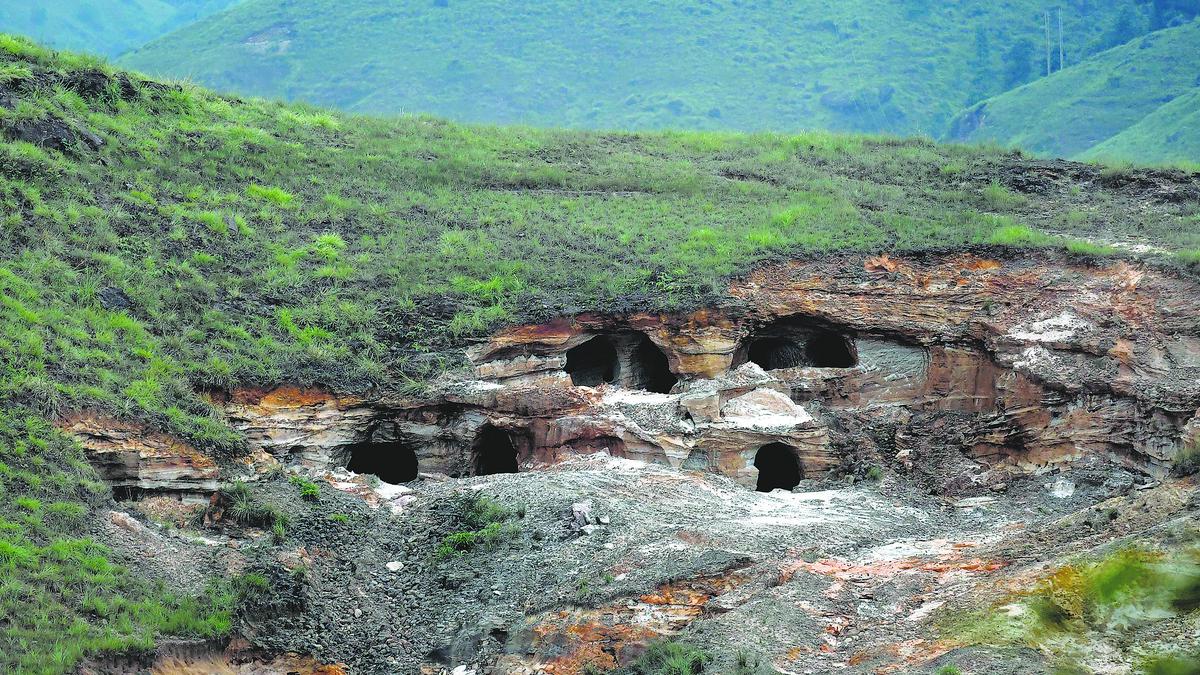 https://www.thehindu.com/news/national/understanding-rat-hole-mining-explained/article67588357.ece the hazards of rat-hole mining — asphyxiation because of poor ventilation, collapse of mines due to lack of structural support, and flooding — to earn thrice or four times as much as working in farms or construction sites. Apart from issues of safety and health, unregulated mining led to land degradation, deforestation, and water with high concentrations of sulphates, iron, and toxic heavy metals, low dissolved oxygen, and high biochemical oxygen demand. At least two rivers, Lukha and Myntdu, became too acidic to sustain aquatic life. In May 2023, Meghalaya Chief Minister Conrad K. Sangma said the Coal Ministry approved mining leases for four of the 17 prospective licence applicants. This would lead to the commencement of ‘scientific’ mining ensuring minimal environmental impact through sustainable and legally compliant extraction procedures. Anti-mining activists, who are assaulted by miners off and on, said that ‘scientific’ would eventually be a fancy tag in a State where profit has driven coal mining.
call for a rethink on River Front Development
Environment body calls for a rethink on River Front Development https://indianexpress.com/article/cities/pune/environment-body-calls-for-a-rethink-on-river-front-development-9044988/lite/
November 28, 2023
The India Rivers Forum, is calling for a suspension of the River Front Development (RFD) project and a proper review with the participation of everybody. “RFDs have been promoted in a big way by the central and state governments across the country in the name of rejuvenating and beautifying the rivers. Some of the prominent sites for RFD projects across India are Varanasi, Bhagalpur, Jaipur, Ahmedabad, Vadodara, Hyderabad, Jammu, Kota, Bilaspur, Patna, Guwahati and Pune. Though RFD aims to revitalise the riverfront areas, in reality these projects are less about river restoration and more about the encroachment of floodplains and riverbeds characterised by heavily concretised embankments and other structures like barrages and also reclaiming floodplains and riverbeds for real estate development. The Pune RFD project follows the same trajectory”.
Decolonize to Decarbonize: Our Call to Action for Climate Justice at COP28
 Decolonize to Decarbonize: Our Call to Action for Climate Justice at COP28 https://www.climatejusticehub.org/wp-content/uploads/2023/11/D2D-Campaign-Briefer-for-COP28.pdf imperialist countries in the global North and their corporations are using the climate crisis to co-opt peoples’ demands to transition away from fossil fuels to further colonise global South frontiers for resource grabbing and exploitation.... Apart from being unscientific or too resource-intensive to deploy at the scale and pace required, these ‘solutions’ are mere ploys to continue burning fossil fuels and profit off of the climate crisis. Worse, these result in what some would refer to as “green grabbing” or “green colonialism” since they historically led to restrictions on people's access to rights, services, and natural resources, including labour rights, healthcare, education, and the Indigenous Peoples' rights to free, prior, and informed consent.
What Killed Gandhi!
 By insisting on non-violence, Bapu extinguished the raging fire of communal violence in many parts of India but he himself fell victim to the bullets of an assassin. But how did it affect India for the next fifty years?
बापू के आख़री कुछ साल | Mahatma Gandhi’s last years | तुषार गांधी https://www.youtube.com/watch?v=MJGcXsochYQ Citizens for Justice and Peace Oct 1, 2023
The last four years of his life proved to be the toughest test of Mahatma Gandhi's principle of non-violence. From Direct Action Day to Partition, when the whole of India was burning in the fire of national hatred and violence, and the leaders of Congress and Muslim League were baking their bread, Bapu alone, risking his life, traveled from 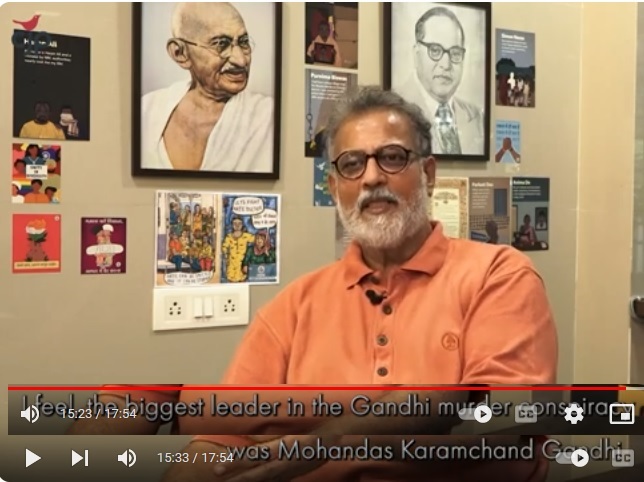 Delhi to Noakhali, Bihar. From Calcutta to Calcutta, he kept fighting for the unity of India, taking support of the stick of non-violence. History is witness to the fact that through this effort he was successful in maintaining peace in the eastern parts of the country, but he had to fall victim to Nathuram Godse's bullet. In his books and also in this interview, Bapu's great-grandson Tushar Gandhi says about his last years that because of this valiant effort, especially as a result of his martyrdom, the wind of national hatred blew in this country for about fifty years, if at all it did not last. Didn't get it.